SSE Report 2020

Self Evaluation Report and Improvement plan
June 2020.
The 2020 school year was extraordinary and unprecedented in schools due to Covid 19. On March 12TH schools were closed with little notification. The normal patterns of movement, school and work changed dramatically for all and the very necessary protocols of isolation and cocooning became the norm.
As always however, the school community rose to the challenge and both teachers and parents quickly adapted to the use of online platforms.
Following consultation with the teachers and inspectorate, the school work was presented weekly online initially and later when it became apparent that schools would remain closed for a lengthy period, the school adopted the use of “Seesaw” as a means of providing daily two way communication with pupils and their parents.
As principal, I would like to congratulate the school staff who had to adopt new methods of work at short notice and put in long hours of preparation and work to ensure the new systems worked well. I would also like to thank the parents for their engagement with the online learning and who also had to get used to a whole new way of life.
The use of this new way of doing things allowed us all to feel connected and to support each other as well as continuing the important work of learning.
In many ways the true meaning of our school Motto “TRÉ NEART LE CHÉILE” has become apparent during this time.
We all look forward to getting back to a sense of normality in September albeit with new protocols to help keep everyone safe.
Self Evaluation Report
SSE -ST. DYMPNA’S NS, KILDALKEY
SCHOOL SELF EVALUATION 2020
SUBJECT: PRIMARY LANGUAGE CURRICULUM- READING
FOCUS: VOCABULARY
For the school year 2020 we have decided to look at Improving Vocabulary in the school. The learning objectives and resources/methodologies are to be used at each class level to improve vocabulary. Pick ones that suit you and use them weekly ,one lesson a week. This can be put in your fortnightly notes as SSE aswell. A report on our work and findings will be written at the end of the year.
Below are the Learning Outcomes for each class:
Element=Understanding
Stage 1
Junior and Senior Infants
Through appropriately playful learning experiences, children should be able to:
$1· Acquire appropriate vocabulary to support the comprehension of text shared by the teacher or read independently.
$1· Talk about and use new vocabulary as it arises, drawing on context and identifying words with similar meaning and words with similar sounds but different meaning.
Stage 2
First and Second class
Through appropriately engaging learning experiences, children should be able to:
$1· Acquire appropriate vocabulary to support the independent comprehension of text.
$1· Draw on a developing knowledge of word structure and word parts, including some prefixes and suffixes, to clarify and discuss the meaning of words.
Stage 3
Third and Fourth class
Through appropriately engaging learning experiences, children should be able to:
$1· Acquire deep and broad vocabulary knowledge to facilitate independent comprehension of texts, to include subject-specific texts.
$1· Draw on an increasing knowledge of word structure and word parts, including prefixes, suffixes and root words , to independently uncover the meaning of words encountered in texts. Use knowledge of synonyms , antonyms , homonyms , homographs and homophones to clarify and discuss the meaning of new and known vocabulary.
$1· Use appropriate reference materials to independently uncover the meaning of unknown words.
Stage 4
Fifth and Sixth class
Through appropriately engaging learning experiences, children should be able to:
$1· Acquire deep and broad vocabulary knowledge to facilitate independent comprehension of texts, to include subject-specific texts.
$1· Draw on an increasing knowledge of word structure and word parts, including prefixes, suffixes and root words , to independently uncover the meaning of words encountered in texts. Use knowledge of synonyms , antonyms , homonyms , homographs and homophones to clarify and discuss the meaning of new and known vocabulary.
$1· Use appropriate reference materials to independently uncover the meaning of unknown word through appropriately engaging learning experiences.
Ideas for Resources and Teaching Methodologies to support teaching vocabulary at each class level:
METHODOLOGIES:
$11. Direct instruction
$12. Teacher modelling
$13. Scaffolding and coaching
$14. Guided practice
$15. Facilitating Independent application
$16. Self-assessment and goal setting
RESOURCES:
· Promoting Children’s Comprehension
· Phonological Awareness
· Developing Comprehension using Wordless Books
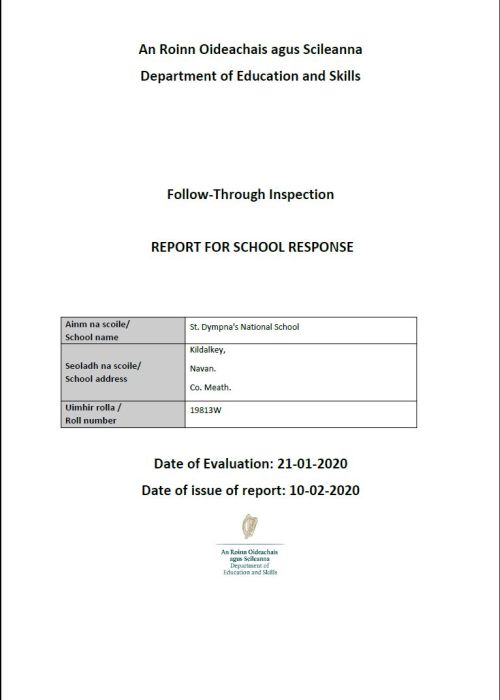
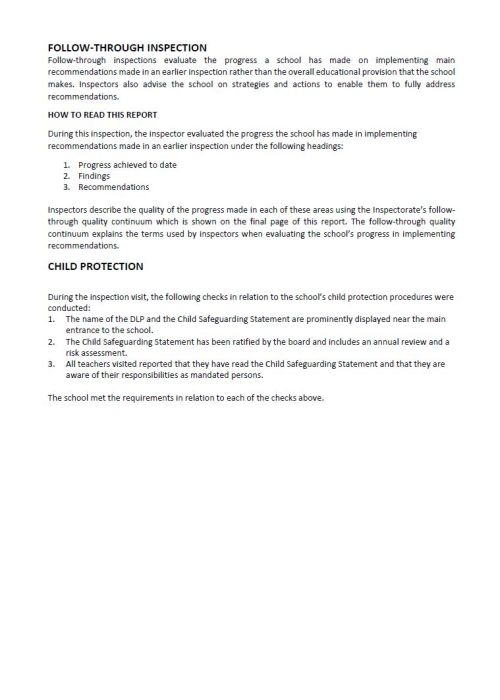
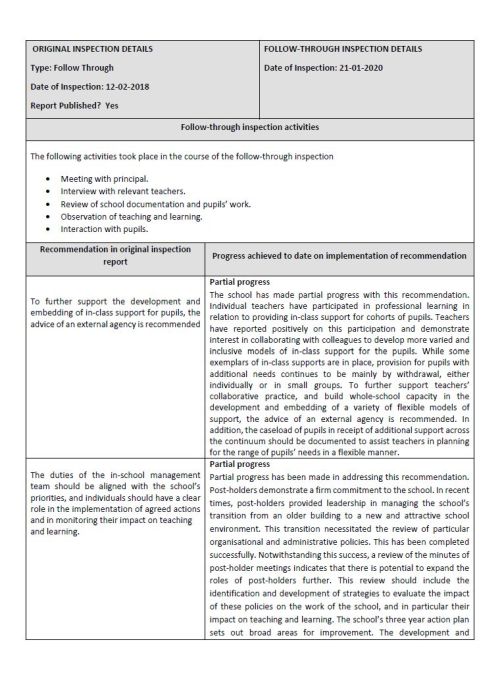
FOLLOW UP INSPECTION REPORT 2020